

This isn’t a blog about AI tools or technology. It’s about leading through AI and how we show up as leaders, for ourselves first and then for our teams, when something bigger than us is changing the world we work in.
The Industrial Revolution reshaped how people worked, where they lived and what a day’s work meant. Electricity, the telephone, and the move from typewriter to computer each changed the world within which people worked, whether they liked it or not.
The people who came through those shifts well were not necessarily the ones who saw them coming first. They were the ones who knew who they were and the value they wanted to bring to the world, and who engaged with the shift from that place. They emerged more successful, more fulfilled, and grown. Those who resisted, withdrew or railed against the change often didn’t end up so well.
We’re in another of those moments. Some of us are excited about AI and embracing it. Others are still figuring out what leading through AI will mean for them and their teams. Some are wary. And many are tired, because it arrives as one more whole learning curve on top of everything else.
We Have Already Been Through a First Wave

In 2020, COVID took away something many leaders had relied on without noticing: the ability to see the work happening. You can’t hover over someone working from their kitchen table. Decision-making spread out. Trust stopped being optional. For many, the temptation to micromanage was still there, but the option largely wasn’t.
Not adapting came at a cost. The uncertainty damaged trust and strained relationships, in both directions. Microsoft’s 2022 research found that 85% of leaders said hybrid work made it hard to feel confident their people were productive, while 87% of employees said they were. Leaders felt vulnerable because they couldn’t see the work, and many people felt doubted. A lot of that has been restored. Some of it hasn’t.
COVID changed how we work, permanently. One small logistical example of that change: Since COVID, our clients stopped phoning us. Instead, they connect by email, by text, and on Teams and Zoom.
We eventually dropped our 1-800 number because the only people still calling it were spammers.
Looking back, COVID set us up for AI. It made us comfortable with digital ways of working. When we wrote Catch the AI Wave at the start of 2025, AI was still something many organizations were watching from the shore. In the last eighteen months, it has become part of how organizations of every size work.
Gallup’s 2026 research found that 99% of the CHROs it surveyed see AI as important to their strategy, yet half aren’t confident their managers can guide people through it. The picture at the very top is similar. In PwC’s 2026 Global CEO Survey, only 12% of CEOs said AI had so far delivered both cost and revenue benefits, and 42% named keeping pace with technological change as their top concern.
The tools are arriving faster than the leadership, but neither you nor your people have to be crushed by the wave; leading through AI is less about mastering every new tool and more about helping people navigate uncertainty. And you are more equipped than you might realise.
The Question Underneath AI Adoption
When I listen closely to leaders and their teams, there’s a question underneath the AI rollouts that nobody puts on the agenda: Am I still needed?
It has two layers.
The first is practical. Will I still have a job? Will I be employable in three years?
The second goes deeper. Can AI do my job better than I can? If I lean in and engage with it, am I setting myself up to be redundant? Will it strip all the meaning from my work?
Why Do We Withdraw When Change Feels Threatening?
Part of what broke down during COVID was deeply human. Think of a cornered animal. The more vulnerable, attacked and unsafe we feel, the more we turn our focus inward, the less care and the less we are at our best.
COVID also exaggerated how differently each of us is wired to respond to threat. Some moved to fight and others to flight. Some leaned into higher risk while others held tightly to safety. Some needed more structure and others needed less. Some believed nothing would happen to them, while others were sure everything would. It was incredibly hard for leaders to navigate, because the same uncertainty was landing on each person differently.
We’re going to see some of those same themes, and some of the same risk factors, as organizations embrace AI. If we don’t embrace it, we will be left behind. It isn’t a question of if, but of how.
Part of a leader’s role is to validate the human response. The fear of being made redundant is real, and so is the risk.
Part of our role is also to be honest about the other side of that risk. If we don’t engage with AI, learn how to work with it, put guardrails around how we use it, and get clear on where AI adds value and where we add value, then we will become redundant, as individuals and as companies, and as individuals we will become less marketable.
Holding back won’t protect us from our fear of redundancy. It’s the very thing that will make it a reality.
Leading through AI is less about mastering every new tool and more about helping people navigate uncertainty. Some aspects we can know and some we can’t. No one of us could have stopped COVID, and no one of us can stop AI. What we can shape is how we respond, how we engage, and what we courageously model for the people watching us.
AI Is Just Another “Other”
Here’s what gives me confidence. This search for meaning isn’t new. Leaders face it whenever they step into a bigger role.
Think about the classic shift from high-performing individual contributor to leader. Your value used to be your own output. Then, almost overnight, your value comes from getting work done through others. Many leaders struggle here, because their sense of being useful was tied to doing the work themselves.
We explored this in 5 Signs Your Best Leader Is Your Biggest Bottleneck. Strong individual performers can become the restriction point in their own system when they can’t let go. Needing to understand how we must shift in order to keep bringing value is nothing new, and it’s likely something you’ve successfully navigated more than once already.
“How do I add value now that AI can do part of what I used to do?” is a different version of the same question every newly promoted leader has had to answer.
The answer hasn’t changed either. Your value moves up.
It moves towards judgement, context, relationships, and the ability to see the bigger picture and help others find their place in it.
That isn’t a loss of meaning. It’s a change in where meaning lives.
It’s also a shift we can equip our people to make, because many of us have already made it ourselves. It’s the heart of what we develop in Coaching Skills for Leaders: moving from being the one with the answers to being the one who asks the questions that release capacity in others.
AI Done Well, AI Done Poorly: The Risk of Being Dumbed Down
My daughter is in business school. She uses AI to turn her textbooks into a podcast. She gives it the context of her course, sets it big systemic questions, and has it debate them. That way she learns the material while making supper instead of falling asleep over a dry textbook. Some of her classmates use AI to do their homework. They hand in the work and skip the learning.
Same tool, very different outcomes. She’s being equipped. They’re being dumbed down, and it showed in the exam, where she scored 98% and the rest of her class scored under 67%.
We see the same pattern in organizations. The City of Kelowna developed an AI tool to help with building permit applications. It answers questions about zoning and city requirements quickly, so applicants find out early where a plan won’t yet meet the standard. Turnaround times improve, and planners spend less time on repetitive work and more on the judgement calls only they can make.
When AI is done poorly, the cause is usually leadership (of self and/or others) rather than technology.
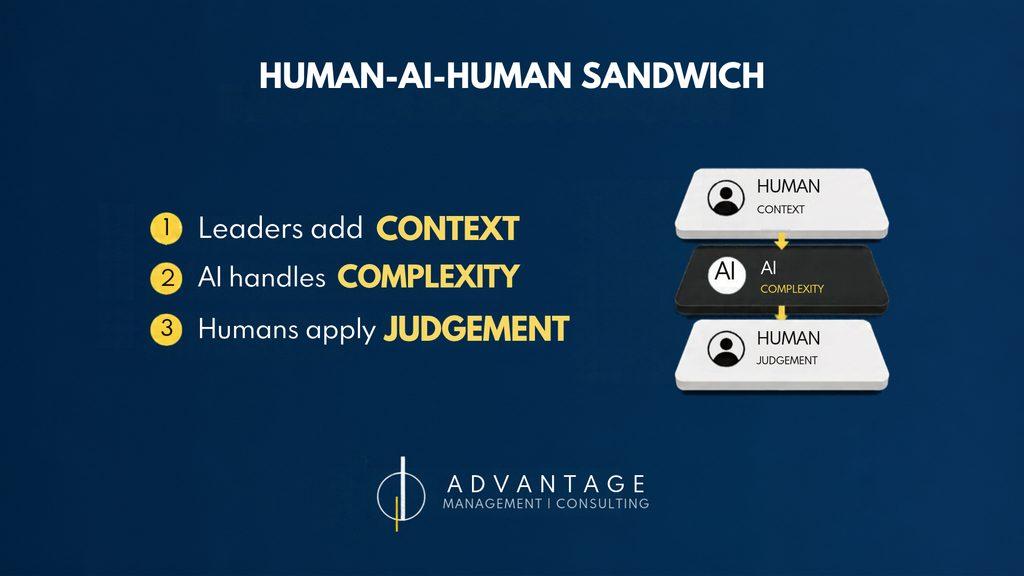
People are too rushed to set up the frameworks, the context and the human role around the tool. In my experience, AI handles complexity remarkably well. What it doesn’t do well is hold context. That’s where people need to show up.
Colin Scotland describes this as a human-AI-human sandwich. People frame the question and supply the context. AI does the heavy lifting on complexity. Then people bring judgement, relationships and meaning to what comes back.
Context is one of the Three Cs we teach leaders, alongside Courage and Compassion, and all three remain deeply human work.
Certainty in Who We Are, Not in What’s Coming
So what is our role as leaders in this second wave of leading through AI? It isn’t to have all the answers about AI. None of us do.
Our role is to be grounded enough in who we are, and in our ability to work things out, that our people can face the uncertainty alongside us. That means not hiding behind the curtain. It means going out ahead, the way a scout would.
We look at what’s shifting, what has opened up and which risks need our attention.
We notice how we ourselves are responding and how our people are responding, and we’re honest about both.
I’ll share a little of my own journey.
Over the past 9 months I’ve been part of a twelve-month AI for Coaches Mentorship with Colin Scotland through coaching.com, and I’ve learned a lot!
- We’ve used AI at Advantage Management Consulting to bring clarity to our overall social media architecture.
- With clients who are excited about it, and with their full permission, I also use it to review our coaching transcripts. It helps name the coaching arc and holds me accountable to the ICF core competencies. Where am I bringing them well? Where is the opportunity for me to do better?
- We’ve also strategically developed a few agents that take on tasks, which frees us to do the work we’re really about.
- We’ve identified several other ways we can use AI to make us more effective in how we serve our team and our clients
The value of AI for “expert” insights, and in removing repetitive tasks, is helping us expand our capability. Inviting a tool to show me my gaps is also what we ask of the leaders we coach: an accurate knowing of your strengths and your gaps, held with enough security that you can keep growing. When we model vulnerability and confidence together, we give our people permission to do the same.
White-knuckling AI, whether by trying to control it or by avoiding it, can feel safer for a while. It just won’t last. A grounded, curious, open-handed posture will.
Whether you sit in HR, carrying the questions about skills, wellbeing and retention, or in Operations, carrying the pressure for turnaround times, quality and return on the tools you’ve already bought, the work in front of you is the same.
Help your people see that their value is moving, not disappearing.
Show them where and how they show up in the human-AI-human sandwich. And let them see you doing it too.
Leaders who learned to trust what they couldn’t see in 2020 already have many of the capabilities required for leading through AI today.
Next month, we’ll get practical, with a set of questions a leadership team can take into planning season to lead through AI as scouts rather than spectators.
Stay connected with monthly insights on leadership, team development, and building strong workplace cultures. Subscribe below to receive practical ideas and inspiration directly to your inbox.
About the author:
Gil Davidson CPCC, PCC, B.Bus Sci (Hons) is the CEO and founder of Advantage Management Consulting, a Canadian leadership and team development firm founded in 2002. She has worked with over 10,000 leaders across South Africa, New Zealand, the UK and Canada.